History of the invention
Prologue
It was middle-April 2003. In the compartment of an InterCity train from Warsaw to Katowice there are two passengers: Jerzy Freliszka, the head of the Electric Power Engineering Laboratory in KOLPROJEKT Project Office and Marek Stolarski, the head of the NEEL company in Warsaw.
The conversation is on the modernization of the E20 railway line between Mińsk Mazowiecki and Siedlce and the talk is about the necessity of installing some system warning animals of approaching trains. The alternative is between erecting wildlife fencing and building an overpass for animals, which had not been included in the documentation of the planned modernization works, or developing and applying a new solution that would meet the assumed functions and fit in the planned costs.
Jerzy Freliszka knew that NEEL used to deal with some “exotic” issues apart from typically connected to railway, for example development and implementation (under a grant from the Committee for Scientific Research) of greenhouse automation systems or microprocessor automation for small waste-water plants. Hence, the straightforward way to an affirmative answer to the question: “Will you take on developing such devices?” D. Sc. Mirosław Ryba, neuroscientist from the Polish Academy of Sciences and an avid hunter, played a very important role in the project, showing the correct way in the selection of the methodology of such devices and the other important man was Jerzy Jakimowicz, who was then Deputy Sales Director in Bombardier (ZWUS) Polska Sp. z o. o., and who believed that we can solve such an unusual problem.
We knew that we had to affect large mammals' senses in order to obtain a deterrent effect. In case of large mammals, the sense of sight and sense of touch are secondary. Most important is the sense of smell, but there are no odour generators that would be suitably efficient and precise. What remained was the sense of hearing, giving us a full range of possibilities.
But how should we use it? What signals to emit? What to do not to let animals get accustomed to the signals?
We purchased a lot of different sounds from the archives of the Polish Radio (barking dogs, shots, moving car, car horn, slamming doors, cough, etc.). Today we know that the general search direction was right, but we lacked detailed knowledge of the subject. We asked for help from specialists from a well-known university, but they told us that it was impossible to make such devices.
Professor Simona Kossak
The breakthrough came in the first half of June 2003 when we met Professor Simona Kossak, Head of the Department of Natural Forests in the Forest Research Institute in Białowieża. She was Jerzy Kossak's daughter, Wojciech Kossak's granddaughter and great-granddaughter of Julius Kossak – all of them famous polish painters – and one of the world's finest ethologists (specialists in animal psychology). At the first meeting she said simply: “I have been waiting for such a meeting for years. I have known for long how such device should work, but I don't know how to make it work."
From that moment things went very quickly. It was still June when we signed an agreement with Bombardier (NEEL as a subcontractor under a contract for the modernization of the E20 railway line, section Mińsk Mazowiecki – Siedlce). At the end of July 2003, after a very meticulous investigation on patent clearance, an invention was reported to the Patent Office and in September three copies of the pre-prototype device passed successfully first tests in a forest near Rembertów. In frosty February 2004 the installation of first devices begun on E20 railway line. They were named UOZ-1 Animal Deterring Device.
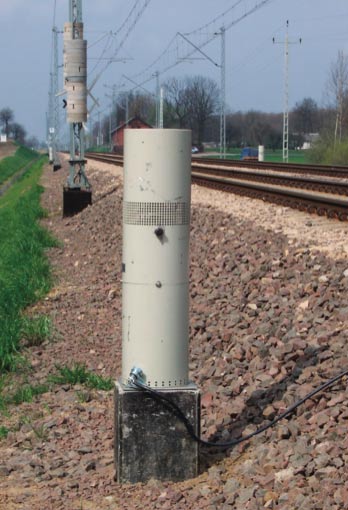
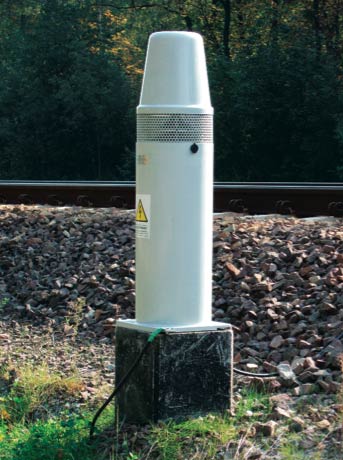
The total of 62 pcs of such devices were installed on a 50-kilometre stretch of the E20 railway line. 30 pieces are used to protect an area where the E20 railway line runs at the edge of a natural reserve “Broszkowskie Ponds” and the others were installed in 8 areas of intensive animal migration across the tracks. They were installed at the tracks, on concrete foundations, in the line of traction poles, approximately every 70 meters on alternate sides of the tracks. The devices have the shape of a thermos, they are about 110 cm high and 30 cm wide in diameter. Inside they are equipped with electronics and a set of two high-performance loudspeakers with circular sound emission characteristics, manufactured specially for us by a well-known Polish producer of loudspeakers TONSIL. Photo 1 shows a UOZ-1 device of the first prototype series and photo 2 shows a unit from the production series, the outer casing is made of epoxy-glass composites.
How does it work?
The key to the functioning of the whole system was the adoption of the principle that the condition for proper response of animals is the transmission of acoustic signals containing information known and stored in their genes. The information should have adequate gravity which means that it must influence on the most important of instincts existing in nature, the instinct of self-preservation. Thus, in the "animal language" – and it means interspecies language – it should send a message: “WARNING! DANGER! SOMETHING REALLY BAD IS HAPPENING!”
If the animal is in an area protected by UOZ-1 equipment (i.e. close to the track or on the track), after hearing a signal, it is supposed to shelter in a safe place for it, i.e. in a forest several or several dozen meters away. The signal sent by UOZ-1 devices starts one minute before the train arrives and ends when it passes through the protected area. Once the train has passed, the UOZs remain silent and the animals may be present or passing through the trackside area without any restrictions.
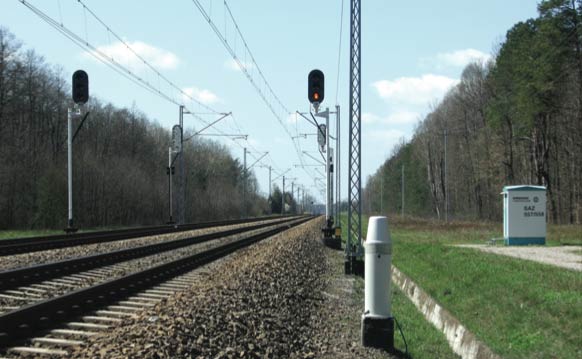
Here the most important advantage of such a solution can be seen, i.e. minimising the barrier effect generated by the animal protection system. Fencing the railway line with high animal fences, although effective from the point of view of animal safety, causes environmental fragmentation, separating animals from their current feeding and breeding territories. After a while there would be a population of white bunnies living on one side of the tracks and black on the other. At the end there would be no bunnies at all since they would extinct as a result of genetic degradation of the species. The mechanism has been shown in a very simplified way, but it illustrates the essence of the risk to animal populations caused by the fragmentation of the natural environment. In case of UOZ system such a scenario should never happen. Photo 3 shows the UOZ-1 devices situated along the railway line E20 running at the border of “Broszkowskie Ponds” natural reserve near Siedlce.
Turning back to the subject of the deterrent signal, the information sent to the animal must be logical, with confirmation of the veracity of its successive fragments. That is why at the beginning of the message the speaker emits alarm call of jay – a bird which for thousand years has warned its mates and other forest animals of danger caused by predators. Next, there are barking dogs, but not just some mongrels, but hound dogs chasing prey. In the final to the dogs there are added voices of animals fighting for life (in the assumption attacked by the dogs) – hare and pigs. The whole sequence is a sound reproduction of an actual situation which often happens to animals, with one difference: the culprit of the “the massacre at the tracks” should be a train. The reaction of wild animals is immediate moving away to a safe distance and watching progress of events.
“Key stimuli”
All the signals that make up the entire sound sequence are called “key stimuli” in zoo psychologists’ language, and the device UOZ-1 is a "key stimuli dummy". Most importantly, these are the signals to which animals should never get used to. If they do, they will die. Sometimes animals are deaf, sick or otherwise disabled. In such cases the natural selection acts mercilessly. The weak and the sick must die, and their place will be taken by others, healthy and in full strength. The same is at the railway tracks. Healthy and fit animals react properly, avoiding collisions with trains. Sick and handicapped are far less likely to avoid the tragedy.
The lesson here is that you cannot completely avoid animal-train collisions. Even if a deer is healthy and fit, during mating season it's behaviour is completely altered. The “priorities” of animal change. The reproductive instinct may drown out the normal response to stimuli that should affect the instinct of self-preservation. And a deer fleeing from a pack of feral dogs? The risk of an animal-train collision is then relatively high, but on the other hand the railway tracks are not a barrier. Animals fleeing in panic or "blinded by love" will always cross the tracks, if only enough determined. And with a little luck they will not end life under the wheels of the locomotive.
Studies on the effectiveness of the UOZ-1 system on section Mińsk Mazowiecki – Siedlce, lasting from spring 2004, showed that to this day there has been only one case of a collision of large mammal with the train on the protected parts of the railway line. A deer was killed, and the accident occurred at the beginning of November 2008, i.e. at the end of the breeding period (warm autumn favours the extension of the period). At the same time there have been recorded many cases of animal-train collisions in areas without UOZ-1 protection. So, the balance is positive, and the practice confirms the theory.
Performance tests
Every invention, especially if it is a novel solution, requires very reliable and sufficiently long scientific research conducted by independent institutions with unquestionable scientific achievements and experience in the subject matter under investigation.
At an international conference in Poznań in September 2006, where there was the world première of the device, the honourable committee asked for research results, the best of a 15-year long research. And it's not a joke as the world of science is suspicious. There have been all sorts of brilliant inventions and concepts which had appeared useless after thorough verification. The only line of defence of Professor Kossak's idea was to show a “hard evidence”. “Hard” that is clear and difficult to undermine.
Time had come for film documentation of animal behaviour. In June 2007 we decided to carry out research on animals’ responses to signals emitted by UOZ-1 devices in a wildlife park in Kadzidłowo. 100 ha large fenced area with free-living roe deer, red deer and wild boar was a perfect place for such observations. If these animals – accustomed to human presence and often born in captivity – would respond to the deterring sequences, that would mean "key stimuli" worked, that is mechanisms of reaction based on of self-preservation instinct stored in the genes. And so, it happened. Filmed reactions clearly showed that all is as it should. Although there was a moment of uncertainty. There were two roe deer which seemed “deaf” and ignored the deterring sounds. Other animals run away to a safe distance, and these roe deer didn't move. They fed on grass as if it was the most important thing in their lives. They eventually moved at the sound of animals being killed. It turned out that they have grown up on a farm in a friendship with watchdogs. Everything was clear.
However, hard evidence is more than that. It is hundreds or even thousands video recordings of animal behaviour, a detailed analysis of the situation, mathematics, statistics, logic, deep knowledge of the animal psychology especially of large mammals. Agricultural University of Warsaw, Faculty of Forestry, Department of Forest Zoology and Wildlife Management is a place of work of researchers who, at the request of PKP PLK S. A. undertook a comprehensive monitoring system for almost two years installed on the E20 line of devices.
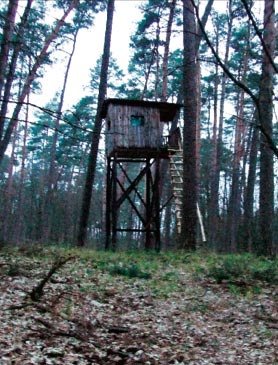
The study was divided into three phases. In winter 2007/2008 animal behaviour study was started in an experimental enclosure in forest near Iława. Inside an elevated hunting blind there were installed a digital camera, IR illuminator and UOZ-1 device driver. The device itself was posed in the forest, close to the feeding ground. Video recordings were taken in there – ant that was phase one.
The second phase was direct observations of the area under monitoring, winter snow tracking, and then tracking on ploughed strips of land located along the railway line, as well as reports on cases of animal-train collisions. The third phase was an installation of digital video cameras in selected sites protected with UOZ devices and a year-long registration and observations of everything that was going on in these areas, started in August 2008.
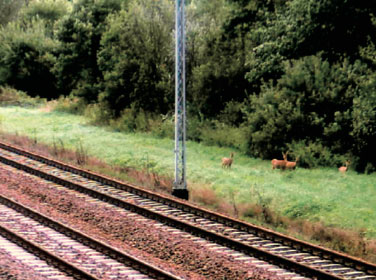 Digital eye of “Big Brother” was observing the railway line for five years. Hundreds of hours of video recordings confirmed the validity of the method of deterrence, confirming the thesis that animals don't leave the railway tracks area, they willingly and quite often remain in the space between railway tracks and the edge of the forest as well as cross the tracks. In one of the videos you can see a roe deer family grazing on freshly mowed space between the tracks and the forest. The loudspeakers of UOZ devices utter sounds of animals fighting for their lives but the roe deer with its offspring are already at a safe distance. After a while the sound sequence ends and you can see a passing train which plays the role of the culprit of the “sound massacre”.
Another, perhaps the most important finding of the video recording analysis is that animals living in the area with UOZ-1 devices hadn't become accustomed to the deterring sound sequences repeated thousands of times. “Key stimuli” and migration routes are working all the time.
In the meantime, on the 15th of March 2007, unexpectedly after a short and severe illness Professor Simona Kossak left us for ever. You could say it was a disaster for all of us, but she had left some very precise instructions on further work on the invention, and so research didn't not stop. We kept working on methods to improve deterrence sequence and technical solutions. And maybe some of you won't believe it, but we still have the feeling as if she still oversaw all the work progress “from above”.
The technique moves forward
Five years after the construction of the first generation of the devices – it is a whole era in the world of electronics. Thanks to modernization of the technology, the power consumption of a single UOZ-1 device was reduced from 80 VA in the prototype series to 15 VA in the current generation of devices. The amount of memory dedicated for storing sound sequences increased many times. At the same time, we were working on the casing. A device of the prototype series weighed about 70 kg. Today one unit weighs less than thirty kilograms and the material used to build the housing is durable thin-walled stainless steel and epoxy-glass.
Turning back to the technology, every good idea is only as good as good is its implementation. You can “spoil” the best idea if you do not take care about the elements critical to the operation of the whole system. In our case, the most critical is the precision of calculating the time of approaching of a train to the protected area. The deterring sequence should begin about 60 seconds before the train would pass the devices – the sequence ends at this moment. Passage of a train should be the finale of the acoustic deterring sequence and the train itself should be perceived as the culprit of the “massacre” at the tracks. It cannot be allowed to leave a several minutes long “holes” between the end of the sequence and the passage of a train. The end of the sequence must “hit the point”. The condition is precise and, if possible, permanent monitoring of the location of oncoming trains.
And what about today? Information on train location is obtained from auxiliary circuits of automatic block signalling (e.g. type SHL-12). Diagnostic module in ABS containers provide data on occupation of blocks allowing to keep track of trains on the virtual map which is part of the UOZ-1 device software. The accuracy of obtaining the information is related to the lengths of the sections of automatic block signal system, which are 1500 to 2300 meters long. If the train runs without sudden speed changes, which are impossible to detect within a single section of the block signalling, calculating the time of commencement of UOZ devices operation is correct and everything is working as it should. A train, which slows down or speeds up abruptly, can “surprise” the UOZ system with earlier or later time of emerging in a specific location of the railway line. Algorithms that calculate the arrival time of the train include the possibility of such situations but have some important limitations. The solution would be to use as a source of information – computer signalling systems with complete data of the trains at the station and the two adjacent routes. The ideal would be trains sending telegrams containing the current position on the route (with a GPS) and speed. Dreams are beautiful, aren't they?
A very important aspect, though rarely mentioned, is the issue of the railway safety, i.e. the other side of the coin. All the time we refer to the animal protection but what about the safety of the passengers? After 2000, there were several spectacular train crashes caused by the collision of the train with large groups of animals. In 2001, on the Rzepin - Kunowice route an express train collided with a pack of 20 wild boar which were roaming along the middle of the track in single file. As a result, the locomotive was derailed. It ended in fear among passengers and a dozen of minor cuts and bruises or so, but the material damage was severe. You can see that the problem is serious and improving the railway safety is just as important as the protection of animal life.
Myths, rumours and doubts
| 1 | Animals will become accustomed to emitted sequences over time. |
| 2 | Animals will run away from the area with installed UOZ devices, and there would be none to detere. |
| 3 | Operation of UOZ devices creates an impassable barrier for animals. |
| 4 |
Operation of UOZ devices causes damage to the natural environment (eg., a negative impact on the birds' habitats). |
Re. 1). It was the first question that we asked Professor Kossak at the beginning of our cooperation. She answered with a question: “Have animals in the forests of Europe got accustomed to the warning cry of jays which has been effectively warning against danger for thousands of years in forest?” Let there be no doubt they have not. The use as deterrent signals of the so-called “key stimuli” should ensure a long-term sensibility of animals to the applied signals, and the use of sequences with variable structure (every sequence is different) eliminates the “sound stamp” feature characteristic for the signals emitted by the first generation of the devices.
The professor compared the situation at the tracks to the reality of the battlefield.
Even the most conscientious in military operations and accustomed to fire and bombardment, the soldier will always react with an attempt to hide in a safe place if he finds himself in a critical situation of imminent danger to life. The habit does not work.
Re. 2). Preliminary studies conducted in the winter of 2004/2005 by the Research Institute of Forestry excluded the concern that the operation of the UOZ-1 devices would result in animals leaving the areas adjacent to protected sections of the railway line and that the sound barrier produced would be so strong that it would make it impossible for the animals to move across the railway line. Animals have not disappeared, and observed animal tracks have shown that UOZs do not make a migration barrier. Observations carried out since the summer of 2008 with digital cameras confirm that animals do not leave the area of railway tracks, are likely to be found between the tracks and the edge of forest as well as cross the railway line. The second very important conclusion of the observation is that animals living in the area had not become accustomed to the UOZ-1 sound sequences repeated thousands of times. “Key stimuli” and migration routes are working all the time.
Re 3). See comment to point 2).
Re 4).
Every human activity has some impact on the surrounding environment. In case of UOZ-1 devices, the sound sequences used are composed of natural sounds that exist in nature, which may have an impact on the environment themselves. But can you forbid a jay or a dog to enter the forest? Or ban barking in the woods? It would be absurd. Hence the simple thesis that environmental harm of Professor Kossak's method is equivalent to the environmental harm caused by environment itself. And the real problem is the people with their “humanist” reception of the unpleasant sounds of animals fighting for their lives. The sounds aren't pleasant, but it is not us who is the recipient, but the animals.
World of nature is very complex. Signals intended for large mammals propagate freely affecting also other animals. An important part of “audience” are birds which cannot be ban from nesting in the close vicinity of the railway line and in the very area protected by UOZ-1 devices. We have heard the opinion that the sound stimuli used may cause birds to escape from the breeding areas there, which are always particularly protected places. The answer will be given by ornithologists, but today we can say that is not so bad. UOZ-1 devices are a static sound source. Their operation does not indicate any movement of the “barking” dogs or “screaming” jays. There is no audible sign of movement of a predator, so birds being some distance away do not feel threatened. And how to evaluate the activities of nesting birds in dense bushes situated just off a very busy street? They must feel safe and they are not disturbed by either the passing people or the ubiquitous traffic noise. Moreover, the programming method of UOZ-1 devices allows for an extremely flexible adjustment of their operation to the existing situation. You can intelligently silence individual equipment or modify acoustic sequences (if necessary) to ensure that breeding areas function smoothly and fully protected animals throughout the rest of the year.
Final
In conclusion, the development of the UOZ system was for us – “born railway man” – the most interesting research topic in the 25-year history of our company. A topic forcing us to learn a completely new knowledge, teaching to have a broader view of the complicated process of coexistence between the worlds of nature and technology, human and animal.
We also decided to rename the devices as Animal Protection Devices. The short name of the UOZ will not change and' deterrence' itself is often understood as negative action. The change will underline the real nature of their functioning, after all, is not about scaring animals, but about protecting them. And we will not conflict with Article 15 of the Nature Conservation Act, which prohibits the scare of animals in strictly protected areas (nature reserves, etc.), although this is not what the creators of the Act meant.
And at the end of 2017, the number of installed UOZ-1 devices exceeded 1000 pcs.
Warsaw, 2009, modified


