Technical information
Introduction:
The subject of this Technical Information are the animal protection devices “UOZ” in the autonomous version, not requiring connection with railway traffic control systems. The document presents a short description of the devices, their construction and basic technical parameters.
Intended use:
UOZ devices are intended for installation along railway lines, for the purpose of preventing the migration of wild animals such as deer, elk, boar and fox across railway tracks during a passage of a train. The purpose of installing devices is to minimize the negative impact of wild animal-train collisions by increasing the railway traffic safety, minimising the losses in the populations of animals, decreasing the amount of damage to the rolling stock and train delays, at the same time not imposing limitations on free movement of animals in their habitats (feeding and breeding areas).
Scope of application:
The devices are designed to be installed on railway lines with speeds up to 200 km/h in places of permanent animal migration. There are no technical contraindications for their use on lines with speeds up to 250 km/h, the only limitation may be regulations related to the protection of human life. Depending on the needs, they can be installed on short stretches, from 400-500 m (point type protection) or long – up to several dozen kilometres long – in large forest complexes (continuous type protection). A natural barrier limiting the use of UOZ devices is dense train traffic with a constant sequence time of less than 5 minutes (railway lines in areas of large agglomerations).
Principle of operation:
The operation of UOZ devices is based on the emission of acoustic signals (warning sequences) using the mechanism of genetically determined fear of natural predators and dangers in animals. These signals are emitted by the UOZ devices for a specified time, just before the train passes. For the construction of acoustic sequences, only sounds naturally occurring in nature are used and they are emitted with natural loudness. The mode of operation does not create a barrier effect, and the railway line and its surroundings can be used by animals practically without restrictions. Only for a short time related to the passage of the train, the animals are deterred away from the track to a safe distance and then they can return to interrupted activities.
The sound sequences were developed by scientists from the Forest Research Institute in Warsaw, specializing in the behaviourism of large animals. They are constructed in such a way as to eliminate the effect of animals getting used to the emitted warning signals. The presence of habitats of protected species does not constitute a contraindication to the use of UOZ devices. The use of UOZ devices does not violate the provisions of the Nature Conservation Act regarding the prohibition of scaring wild animals.
Construction and operation:
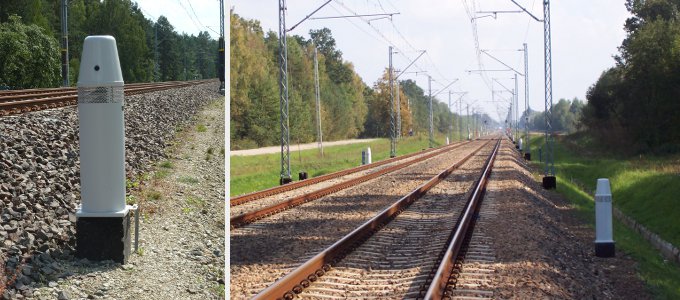
The complete UOZ animal protection system in the autonomous version consists of UOZ track-side devices and MDS-UOZ diagnostic and control modules cooperating with them, installed in RUOZ track-side cabinets, and wheel sensors installed on each track at both sides of the protected area at a distance of 2 – 4,2 km from its border (for speeds 120-250 km/h). The trackside device is installed permanently on a concrete foundation, placed next to the track, in the line of traction poles, alternately every 65-70 m (measured along the track axis). The RUOZ cabinet, which controls the operation of trackside devices and supplies them with electric power, should be installed at a distance of approx. 8-10 m from the axis of the nearest track, in the area belonging to the railway. One RUOZ cabinet can control the operation of up to 48 UOZ track-side devices, which corresponds to the length of the protected area of approximately 3300 m. The shortest section of 400-500 m requires the installation of 8-9 track-side devices. Shorter sections should not be used due to the documented phenomenon of frequent walking around them by animals and an increased risk of collision outside the protection area.
The trackside UOZ devices belonging to one animal protection point are connected with each other and with the diagnostic and control module MDS-UOZ cooperating with them with a fibre optic cable communication system. UOZ trackside devices are powered by cables from the RUOZ cabinet, with separated voltage of 230V AC. The necessary electrical equipment is located inside the RUOZ cabinet. In the case of installation on an electrified line, the trackside device is adapted both to grounding and to connection with elements of the group railing, using multiple-action thyristor jumpers, equalizing the potential of the UOZ housing with the potential of the running rail (for direct voltages 1.5 and 3kVDC).
Activation of trackside devices is based on information obtained from wheel sensors, which provide data about the direction of movement and speed of oncoming trains. The operation of the UOZ devices is switched off automatically after the end of the sequence emission or after detection of the train passage through the protection area using signals from lidar sensors installed on several trackside devices. If it is necessary to track the train's movement through the area of the train station, it may be necessary to install additional wheel sensors there.
The wheel sensor measurement and communication interfaces can be installed in the RUOZ-CK track-side cabinet (in the case of monitoring the area of the railway station) or in the MDS-UOZ module of the RUOZ cabinet.
UOZ devices are equipped with a NEEL-WIZ diagnostic system using GSM 3G or 4G connectivity, allowing to remotely monitor its operation and detect and locate any malfunctions. Detailed information about the location and type of damage can be displayed on the screen of a computer, tablet or smartphone with an installed browser such as Firefox, Chrome etc. The devices are also equipped with an anti-theft protection system that reacts to attempts to disassemble or destroy the housing. In case of detection of an attempted destruction or burglary, all devices belonging to one warning group emit an acoustic alarm signal for 90 seconds, and the information about the burglary is sent to the selected place of supervision.
Detailed information on the design, assembly and maintenance of system components can be found in the Technical and Operation Documentation of animal protection devices on the railway line.
Technical specifications:
The UOZ-1 trackside device is designed for operation outside, within a temperate climate.
| Weight of the UOZ-1 device | 290N (~28 kg) |
|
Weight of the foundation
|
1.85kN (~180 kg) |
| Level of protection – electronics module | IP 65 |
| Power supply | 230VAC, (separated voltage) |
| Nominal current | In = 0,12A |
| Nominal power consumption in standby mode | 5VA, cosφ>0.6 |
| Maximum power consumption during sound emission | 28VA, cosφ>0.7 |
| Overcurrent protection type | C2 type installation switch |
| Test voltage (insulation) | 4000 V RMS |
| Digital data transmission | RS485 |
| Transmission speed | 9600-19200 baud |
| Emitted sound level 1kHz / 1m | ~90dB (test signal) |
| Environmental temperature | -40°C to +55°C |
| Max. relative air humidity | 100% |
| Type of operation | continuous operation |
Dimensions
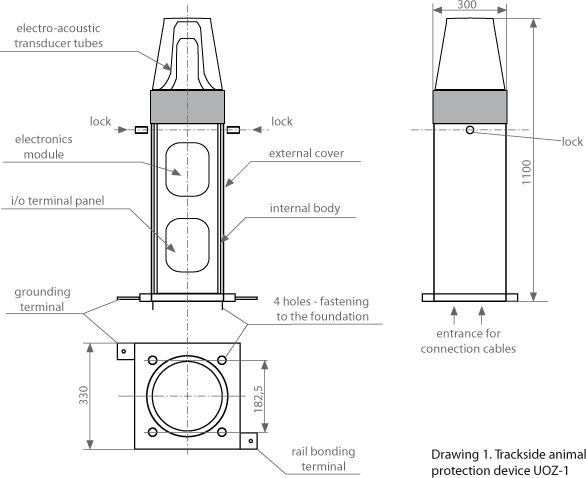
The construction and dimensions of the device are presented in Drawing 1.